Aarke French Press First Look: Unboxing and Impressions
Introduction
The Aarke French Press positions itself at the intersection of form and function, promising a modern take on a familiar brewing method. For buyers who care about kitchen aesthetics as much as coffee quality, the Aarke offering aims to be both a statement piece and a reliably performing device. This first-look review covers the unboxing experience, the materials and build, brewing performance, everyday usability, and how the press stacks up against typical alternatives. It is written to help potential buyers decide whether the Aarke French Press meets their priorities—durability, heat retention, ease of cleaning, and of course, coffee taste.
Unboxing and First Impressions
Packaging and presentation
The Aarke French Press arrives with packaging that mirrors the brand’s broader design ethos: minimalist, tidy, and carefully organized. Inside, components are snugly packed to prevent movement in transit. The presentation leans toward the premium end of the spectrum—materials are wrapped or cushioned with simple protective layers rather than excessive plastic. For buyers who value first impressions, the unboxing signals that attention was paid to both aesthetics and protection.
Included components
The box typically contains the glass beaker (often borosilicate for temperature resistance), a stainless-steel outer frame, the plunger assembly with a multi-layer mesh filter, and an instruction leaflet. The plunger may arrive partially assembled to prevent damage. Replacement parts are commonly available for high-quality presses, but buyers should check availability and warranty policies for peace of mind.
Design and Build Quality
Materials and finish
Aarke’s design language favors polished stainless steel and clean lines. The French Press reviewed here combines a stainless-steel chassis with a clear glass carafe, presenting a modern, restrained look that integrates well in contemporary kitchens. The metal finish feels solid under the hand and resists fingerprints better than high-gloss alternatives. The carafe's glass appears thick and well seated in the frame, which contributes to an impression of robustness.
Ergonomics and handling
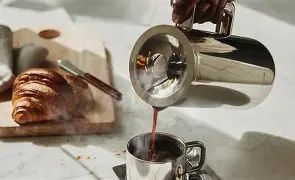
Ergonomically, the handle and spout are designed for controlled pouring. The handle gives a secure grip even with a full carafe, and the spout pours cleanly with minimal drips when the plunger is depressed. The plunger’s knob provides a confident purchase for steady downward pressure, and the mesh filter moves smoothly without wobble, which is crucial for consistent extraction.
Brewing Performance and Analysis
Extraction and taste
In a French press, extraction is governed by grind size, steep time, water temperature, and agitation. The Aarke French Press does not change those fundamentals, but its practical impact shows up in how well it isolates flavors and how clean the finished cup is. With a medium-coarse grind and a 4-minute steep, the resulting cup highlights body and sweetness as expected from immersion brewing. The multi-layer stainless-steel filter reduces sediment compared to single-mesh designs while preserving oils and mouthfeel.
Heat retention
Glass carafes typically lose heat faster than insulated stainless-steel alternatives. The Aarke configuration—stainless-steel frame with a glass beaker—trades off insulating performance for visual clarity. In practice, initial brew temperatures are appropriate when preheating steps are followed (preheat carafe with hot water, discard before brewing). Heat retention is adequate for single-brew use at the counter but less ideal if the brewed coffee needs to stay hot for extended periods without reheating. Buyers concerned with thermal longevity should consider a double-walled stainless-steel press or a thermal carafe for storage after brewing.
Filter quality and clarity of the cup
The plunger assembly includes a fine mesh filter and often a disk or gasket to create a better seal against the carafe walls. This assembly reduces the amount of fine sediment in the cup while maintaining the full-bodied character French press drinkers expect. Aarke’s filter is made to slide straight and resist clogging; small, soluble particulates still pass through by design, contributing to texture and flavor but not excessive grit.
Discover deals on Electronics — updated daily.
View Offers →Usability: Daily Workflow and Cleaning
Daily use of the Aarke French Press follows the familiar three-step routine: add coffee, pour hot water, wait and plunge. The press’s design makes each step intuitive. The wide mouth simplifies adding grounds and pouring water, and the plunger action is consistent across repeated uses. The press fares well on an office counter or in a small kitchen where visual design is a priority.
Cleaning and maintenance
Cleaning is straightforward: disassemble the plunger, discard grounds, rinse the beaker, and wash each component. Because the carafe is glass and the frame separates cleanly, most parts are top-rack dishwasher-safe when verified by the manufacturer. The stainless-steel filter benefits from an occasional deep clean—soaking in warm water with a mild detergent and brushing the mesh will keep extraction consistent. Buyers should note that some premium presses have small crevices where grounds can collect; regular rinsing prevents buildup and extends the lifetime of seals and gaskets.
Real-World Use Cases
Understanding real-world applications helps clarify whether this press fits a buyer’s routine:
- Morning ritual at home: For users who brew one or two presses to begin the day, the Aarke French Press offers a visually pleasing ritual and a reliably flavorful cup. The aesthetic presence on the countertop doubles as decor.
- Office or shared workspace: Its straightforward operation and durable build make it suitable for small office kitchens where a handful of coffee drinkers share equipment. The glass beaker provides a quick visual cue of remaining coffee.
- Entertaining guests: The press produces fuller-bodied coffee that pairs well with breakfast or dessert service. The stainless-steel exterior complements modern table settings.
- Small apartments or design-conscious kitchens: Buyers with limited counter space or an eye for design will appreciate the compact footprint and clean lines.
What Buyers Typically Care About
Prospective buyers usually prioritize the following considerations:
- Build quality and longevity: Is the frame sturdy? Will the glass resist thermal shock?
- Ease of cleaning: Can the press be thoroughly disassembled? Are replacement parts accessible?
- Heat retention: Will the coffee stay hot long enough for the user’s routine?
- Filter effectiveness: Is the cup acceptably clear of sediment?
- Design and countertop presence: Does the press fit the kitchen’s aesthetic?
Pros & Cons
- Pros:
- Elegant, minimalist stainless-steel design that fits modern kitchens
- Solid build quality with a reassuring weight and finish
- Multi-layer filter reduces excess sediment while preserving body
- Intuitive unboxing and easy daily operation
- Easy-to-clean components that disassemble without tools
- Cons:
- Glass carafe limits heat retention compared with thermal models
- Higher upfront cost relative to basic glass presses (value depends on design priorities)
- Some parts (like fine mesh filters or gaskets) may require occasional replacement
- Not ideal for long-term hot-holding without transfer to a thermal vessel
Comparison Table: Aarke French Press vs. Common Alternatives
| Feature | Aarke French Press | Standard Glass French Press | Insulated Stainless-Steel Press |
|---|---|---|---|
| Design | Modern, polished stainless-steel frame with clear glass beaker | Simple glass and wire or cast frame, functional | Robust, utilitarian metal body; less transparent |
| Materials | Stainless steel + borosilicate glass (typical) | Glass beaker, plastic or metal frame | Double-walled stainless steel |
| Heat retention | Moderate — preheat recommended | Low — cools quickly | High — keeps coffee hot for hours |
| Durability | High for frame; glass beaker vulnerable to impacts | Glass beaker is fragile | Very high; resists drops and bumps |
| Cleanability | Easy to disassemble; dishwasher-safe parts often | Easy but filters can be basic | Can be slightly harder to dry inside; components often dishwasher-safe |
| Cup clarity (sediment) | Good — multi-layer filter minimizes grit | Varies — basic mesh may let more fines through | Good — fine filters available |
| Best for | Design-conscious buyers who brew at home | Budget buyers and casual users | Users needing thermal longevity and ruggedness |
Buying Guide: How to Choose a French Press
When assessing whether the Aarke French Press or another model is the right purchase, consider the following factors:
1. Material and build
Decide between glass and stainless steel. Glass provides visual feedback and a classic look, while stainless steel offers superior durability and insulation. If design and transparency matter, a well-built glass beaker in a sturdy frame—like the Aarke approach—can be a strong choice.
2. Filter quality
Filters vary from single-mesh to multi-layer systems. Multi-layer stainless-steel filter assemblies reduce sediment while allowing oils that contribute to body to pass through. For the cleanest cup, choose presses with fine, well-seated filters.
Find top-rated Electronics products at great prices.
See Deals →3. Capacity
French presses come in sizes that serve one to several people. Select a capacity that matches typical use: single-serve for solo drinkers, 3–4 cup for couples, larger for entertaining. Avoid overfilling smaller carafes or using too-large presses for single servings, as temperature and extraction dynamics change with volume.
4. Heat retention needs
If coffee needs to remain hot for long periods, consider insulated models or plan to transfer brewed coffee to a thermal carafe. A glass-bodied press with preheating can be excellent for immediate consumption but not for prolonged hot-holding.
5. Ease of cleaning and spare parts
Look for presses with easily removable plungers and accessible filters. Check whether components are dishwasher-safe and whether manufacturer replacement parts (filters, gaskets, glass beakers) are readily available. This affects long-term ownership costs.
6. Countertop footprint and storage
Consider width and height if storage or counter space is limited. The Aarke design typically aims to be compact and visually unobtrusive while offering a stable base for brewing.
7. Aesthetic and integration with kitchen design
For many buyers, the press is not only a tool but a display piece. If the coffee maker will live on the counter, choose a finish and form that complement the kitchen. The Aarke French Press favors a minimalist, contemporary look that integrates into modern spaces.
Conclusion
The Aarke French Press presents a compelling option for those who prioritize design without sacrificing the fundamentals of a good French press. It delivers a solid build, a pleasant unboxing experience, and a filter system that strikes a balance between body and clarity. The primary trade-off is heat retention inherent to glass-bodied presses; for users who need long-term thermal performance, a double-walled stainless-steel option may be preferable. For everyday home brewers, design-conscious buyers, or those who enjoy a ritualized, tactile brewing experience, the Aarke French Press is worth considering as part of a well-rounded coffee toolkit.