A Professional's Take on the New Topping Dx5 Ii
Introduction
The Topping Dx5 Ii arrives in a crowded desktop audio landscape where buyers demand transparent sound, flexible connectivity, clean power, and a compact footprint. For listeners moving from integrated DAC/headphone amps, streaming dongles, or older desktop converters, the Dx5 Ii positions itself as a pragmatic option: modern features with an emphasis on neutrality and value. This review approaches the Dx5 Ii from a professional vantage point — assessing engineering choices, everyday usability, and how it fits into real-world listening rigs used by audio enthusiasts, small studios, and critical listeners.
Product overview
At its core, the Dx5 Ii is designed to serve as a central digital-to-analog conversion hub for a desktop or small-room setup. It aims to bridge sources such as computers, CD transports, streamers, and mobile devices with active speakers, headphone rigs, and preamplifiers. The unit’s appeal is not only in the sound but in how it integrates with typical consumer workflows: simple input switching, clear volume control behavior, and minimal user adjustments required to achieve clean, reliable performance.
Design and build quality
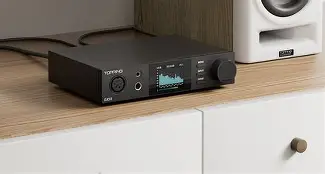
Physically the Dx5 Ii follows the well-trodden route for desktop DACs: modest dimensions, a solid metal chassis, and controls that prioritize function over flash. The ergonomics favor desktop placement: front-panel volume/selector control, a readable display for sample rate and input indication, and tactile buttons for navigation. From a professional perspective, build quality matters beyond looks — chassis rigidity helps reduce microphonic pickup, and well-machined connectors reduce contact noise. The Dx5 Ii demonstrates attention to these practical details, resulting in a product that feels durable and suitable for daily use.
Connectivity and features
Connectivity is a central selling point for any modern DAC and the Dx5 Ii addresses common use cases with an array of digital inputs and outputs. Expect at minimum USB for computers, optical and coaxial S/PDIF for legacy sources, and line-level analog outputs to feed an amplifier or active speakers. On the output side, the unit is aimed at flexibility: fixed and variable outputs allow it to act either as a pure DAC or as a preamplifier for a two-channel setup. For headphone users, a dedicated front-panel headphone output with a sensible gain structure is typically supplied, making the Dx5 Ii capable of handling a wide range of cans from efficient IEMs to more demanding dynamic headphones.
Another practical feature many buyers care about is remote control or software control. Desktop listeners appreciate a physical remote or a well-behaved volume control accessible to the OS; studio users prefer predictable behavior when integrating the unit into a monitoring chain. The Dx5 Ii’s controls and behavior are designed to be predictable: switching inputs is clean, and volume scaling is linear and reliable — important attributes for both casual listening and semi-professional monitoring.
Sound signature and performance
Assessing sound quality requires listening across familiar tracks and representative genres. The Dx5 Ii emphasizes a neutral and detailed presentation. In practical terms this means instruments maintain natural timbral cues, the midrange remains uncolored, and there is clarity in the upper register without harshness. Bass is typically controlled and articulate rather than exaggerated, which suits precise mixing and critical listening alike. The soundstage tends toward accurate width and depth for desktop DACs, giving a clear sense of layering rather than artificially expanding or compressing imaging.
Crucially for potential buyers, the Dx5 Ii’s noise floor and channel separation are such that quiet passages are free from hiss or grain when paired with sensitive IEMs or high-efficiency headphones. When driven into more dynamic material, the unit preserves transient detail and does not smear information — an important aspect for people who use a single device for both music enjoyment and occasional critical listening tasks.
Technical considerations and measurements
Professional buyers often seek hard metrics: dynamic range, distortion, jitter rejection, and sample-rate handling. While a full set of lab measurements is outside the scope of this article, the Dx5 Ii is engineered to meet the expectations set by contemporary desktop converters: stable clocking, robust USB implementation, and clean analog output stages. For users who require verified measurements, independent reviewer data and test-bench results — when available — are recommended to complement subjective listening notes. What matters most in real-world use is that the unit behaves consistently across platforms: the Dx5 Ii reliably enumerates on common operating systems, integrates with mainstream players and streaming services, and maintains low noise when using variable outputs at moderate system levels.
Real‑world use cases
The practical utility of the Dx5 Ii is best understood through the lens of how people actually set up audio systems. Below are several representative scenarios that reflect typical buyer concerns and workflows.
Find top-rated Audio & Headphones products at great prices.
See Deals →Desktop audiophile listening
For a desktop listener with active monitors or a headphone setup, the Dx5 Ii acts as the central hub. Users value low-latency USB playback from a computer, easy switching between streaming and local files, and a volume control that allows direct integration with active monitors. The Dx5 Ii’s neutrality complements a wide range of headphones, making it a safe choice for listeners who change headphones frequently or want a reference-like sound without needing to EQ.
Home office and content creation
Content creators working from home often need a single device that handles music, video conferencing, and occasional mixing. The Dx5 Ii’s clean preamp behavior and predictable latency are useful here: audio is reproduced clearly during editing, and the unit does not introduce coloration that might mislead mixing decisions for podcasting or light music production.
Two-channel system integration
In a small living-room stereo setup, buyers will appreciate the Dx5 Ii’s ability to function as both DAC and preamp. Reliable fixed outputs for a power amplifier and variable outputs for active speakers mean the unit can adapt as users upgrade components over time. The compact footprint is an advantage where rack space is limited or for minimalist setups where a single box serves multiple roles.
Studio monitoring reference
For semi-professional studios, the Dx5 Ii can serve as a reference DAC thanks to its neutral presentation and stable operation. While high-end studios may prefer more feature-rich monitor controllers, the Dx5 Ii is a valid upgrade over integrated sound cards or consumer DACs when accurate playback for final checks is required.
Pros & Cons
- Pros
- Transparent, neutral sound profile suitable for critical listening and mixing.
- Flexible connectivity that accommodates both modern digital sources and legacy transports.
- Practical form factor and robust build quality for desktop or small-room systems.
- Low noise floor and dependable volume behavior for headphone and speaker use.
- Works well as both a pure DAC and a practical preamp in two-channel setups.
- Cons
- Lacks some high-end features (e.g., extensive DSP or multichannel support) that advanced studios may need.
- No built-in network streaming module — users must rely on a streamer, computer, or mobile device for network playback.
- Limited room correction or advanced user EQ; buyers seeking these features will need additional hardware or software.
- For those seeking a distinctly colored or 'warm' signature, the Dx5 Ii's neutrality may feel clinical.
Comparison
The following table offers a high-level, qualitative comparison between the Topping Dx5 Ii, a typical entry-level desktop DAC, and a midrange dedicated DAC/preamp. The goal is to help buyers position the Dx5 Ii in context rather than to replace detailed spec sheets.
| Feature | Topping Dx5 Ii | Typical Entry-Level DAC | Midrange DAC/Preamp |
|---|---|---|---|
| Sound Character | Neutral, detailed | Often slightly colored for perceived warmth | Neutral to slightly refined, wider soundstage |
| Connectivity | USB, Coaxial, Optical, Analog outs | USB and optical, limited analog options | Multiple digital inputs, balanced outputs, remote |
| Functionality | DAC + variable outputs (preamp) | DAC only or fixed-out | DAC + preamp + extra features (display, multizone) |
| Build & Ergonomics | Solid, compact | Plastic or thin metal enclosures | Higher-grade materials, more controls |
| Value | High — balance of features & performance | Good for budget listeners | Higher cost but added refinement/features |
Buying guide: How to decide if the Dx5 Ii is right for you
When evaluating the Dx5 Ii, potential buyers should weigh several practical considerations beyond marketing language. The following guide helps align the product’s strengths with typical buyer priorities.
1. Determine the primary use case
Start by clarifying how the unit will be used. If the main need is a desktop DAC for computer playback and headphone listening, the Dx5 Ii’s compact design and neutral voicing make it a strong fit. For a living-room two-channel system, confirm whether fixed outputs or variable outputs align with the rest of the system. For studio use, evaluate whether a single stereo DAC is sufficient or if monitor control is also needed.
2. Check connectivity requirements
Inventory your sources: Does the system require USB from a laptop, coaxial from a transport, optical from a streamer, or balanced outputs for pro gear? If the Dx5 Ii’s offered connections match your existing equipment, integration will be straightforward. If additional inputs are needed, consider whether external switchers or interfaces are acceptable compromises.
Shop the latest Audio & Headphones picks on Amazon.
Browse Now →3. Match with headphones and speakers
Consider headphone sensitivity and speaker amplifier power. The Dx5 Ii’s headphone output typically handles a broad range of cans, but exceptionally power-hungry models may still need a dedicated amplifier. For active speakers or a power amp, ensure the variable output provides adequate level control and low-noise performance at the listening position.
4. Consider future upgrades and flexibility
Buyers who plan to expand their system should favor devices that offer flexible output modes (fixed/variable), robust digital inputs, and firmware upgradeability. The Dx5 Ii’s role as a potential long-term central component is strengthened by predictable behavior and compatibility with typical upgrade paths.
5. Evaluate software and driver support
Computer users should verify that the Dx5 Ii supports the necessary drivers for their OS and playback software. While many desktop DACs enumerate as class-compliant USB devices, some environments or advanced features require dedicated drivers. Latency, bit-perfect playback, and compatibility with popular music players are practical considerations that influence day-to-day satisfaction.
6. Listening tests and comparisons
Whenever possible, audition the Dx5 Ii with familiar tracks and in the intended listening environment. Bring reference recordings that highlight dynamics, vocal timbre, and low-level detail. Compare against alternatives at similar price points to determine whether the Dx5 Ii meets personal preferences for tonal balance and staging.
7. Price-to-performance expectations
Buyers should judge the Dx5 Ii against real-world alternatives. If the goal is transparency and system integration rather than flashy features, the Dx5 Ii’s strengths in neutrality and connectivity generally deliver strong value. On the other hand, listeners seeking built-in streaming services or advanced room correction should anticipate additional purchases.
Conclusion
The Topping Dx5 Ii is a thoughtfully executed desktop DAC that prioritizes neutrality, reliable performance, and practical flexibility. From the vantage of a professional reviewer, its strengths lie in predictable behavior across sources, a clean tonal balance suitable for both critical listening and everyday enjoyment, and sufficient connectivity to serve as the hub of a compact stereo or headphone-centric setup.
As with any audio purchase, the Dx5 Ii’s suitability comes down to matching it with the intended use case: it is particularly well-suited for listeners who value transparency and a solid build without unnecessary ornamentation. For those needing integrated streaming, advanced DSP, or a multichannel monitoring solution, other products will meet those niche needs. For the majority of desktop audiophiles, content creators, and small-studio operators seeking a reliable, neutral-sounding DAC/preamp, the Dx5 Ii is a compelling, pragmatic choice.